
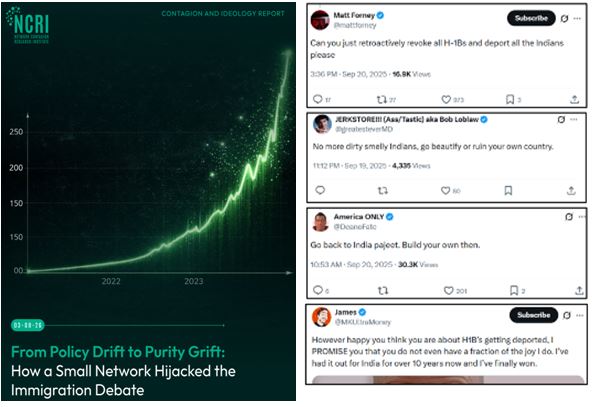
11th March 2026 – While the House of Commons in Canada is debating on Combatting Hate Act, the neighbour down South has taken the anti-Indian sentiment to a different tangent.
US-based think tank Network Contagion Research Institute (NCRI) has published a shocking report about rising anti-Indian and anti-Hindu sentiment on social media platforms and offline.
As per the report, anti-Indian content on social media platform X has tripled in weekly volume in 2025. In a span of 12 months, i.e., from January to December 2025, such posts have accumulated over 300 million views across more than 24,000 tweets.
As the debate got hotter over visa and labor systems, the narrative shifted into collective blame language framing Indians as demographic “invaders” and “economic replacers”.
The report highlighted that the online escalation coincided with offline targeting which included attacks on Hindu places of worship and even elected officials calling for mass deportation of Indians.
The report noticed that although Indian-Americans households earn a median annual income of US$ 151,200, which is well above the national median in the US, and contribute positively to the US economy, the Indo-Americans have come under severe attacks from the ultra-right. Report also captured other notable contributions of the Indo-American diaspora including”
- 77% of age 25 and over hold at least a Bachelor’s degree
- Significant under-representation in federal prison population
- 9 of 10 hold favourable view of the US
- Fiscally net-contributing, employment-generating and civically integrated
Noticeably, Indian-Americans hold a high view of President Donald Trump. In October 2022, Trump had even promised to build Hindu Holocaust Memorial.
The report further noted a spike of online hate against the Indian-American elected representatives including Vivek Ramaswamy, Rep. Shri Thanedar, Rep. Pramila Jayapal and FBI Director Kash Patel. The hate campaign against the Second Lady Usha Vance grew significantly as the probability of JD Vance’s presidential candidature for 2028 became more noticed.
According to the report, the below accounts were found to be Top repeat posters of anti-Indian content:
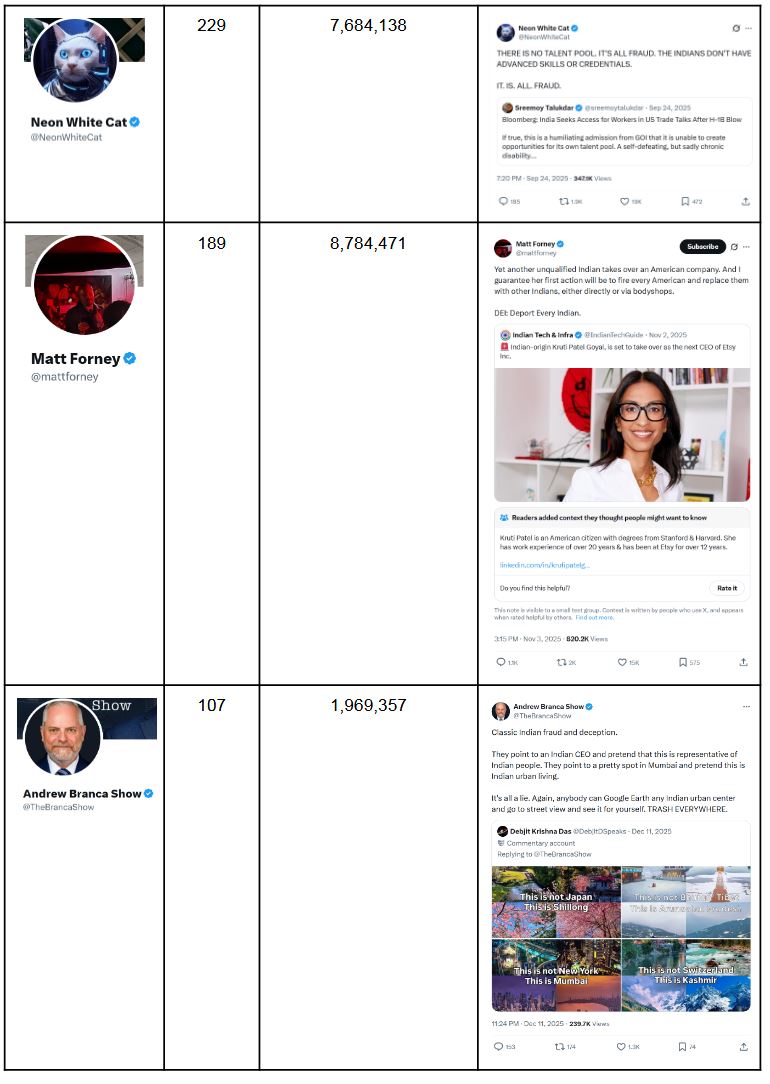
The report concluded that:
- Policy-Content Correlation: Increases in anti-Indian content correspond with immigration policy developments, with the largest spike following the September 2025 H-1B fee announcement.
- Narrative Shift: A temporal shift from explicit slurs (early 2025) toward policy-framed content (mid-to-late 2025) may reflect adaptation to moderation or changing strategic preferences among content creators.
- Concentrated Amplification: A small number of high-activity accounts drive disproportionate reach, suggesting that anti-Indian content is significantly shaped by dedicated actors rather than representing purely organic sentiment.
- Public Figure Targeting: Indian-American public figures, particularly those associated with immigration policy positions, are frequently mentioned in anti-Indian content.
- Extremist Network Overlap: The accounts and individuals driving anti-Indian content overlap with networks previously identified in connection with antisemitic campaigns, suggesting anti-Indian content is integrated into a broader ecosystem of ethnic hostility.
Read the full report here – https://networkcontagion.us/reports/from-policy-drift-to-purity-grift-how-a-small-network-hijacked-the-immigration-debate/
