
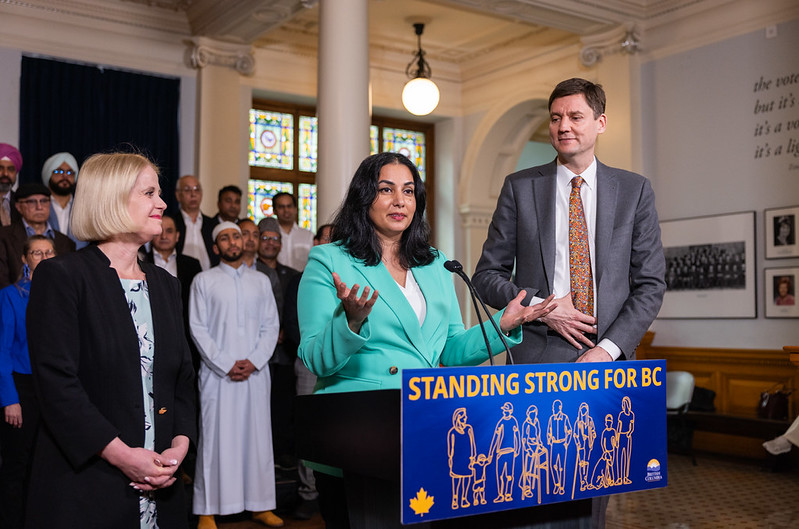
12th March 2026 – Early this week, the Government of British Columbia introduced a new legislation which aims to prohibit people from interfering with safe access to places of worship.
Safe Access to Places of Worship Act or SAPPWA or Bill 13 intends to create “protections for people accessing places of worship, such as mosques, temples, gurdwaras, synagogues and churches.”
We communicated with the Honourable Attorney General (AG) and Deputy Premier of British Columbia, Niki Sharma, and asked her questions about this bill.
HTC: What is the basis of bringing this bill to the Legislative Assembly?
AG: In recent years, there has been a rise in confrontations and targeted disruptions at religious buildings like gurdwaras, temples, synagogues, mosques, and churches. In some cases, courts have had to step in and order buffer zones be set up. We’ve heard deeply troubling stories from faith leaders about elderly community members feeling afraid to attend services simply because of crowds gathering outside and using intimidation tactics. No one in British Columbia should feel unsafe when trying to practice their faith. These incidents undermine safety, cause fear, and interfere with people simply trying to access their place of worship.
The recently introduced Safe Access to Places of Public Worship Act (SAPPWA) targets this type of action, allowing for access zones to be established around eligible places of worship, within which certain harmful, disruptive, or intimidating behaviour will be prohibited.
HTC: Should this bill be passed, what is expected of the places of worship?
AG: Under the new law, an eligible place of worship that wants to access the protections under the legislation will be able to do so by putting up a sign that is clearly visible to indicate it is protected. The sign must clearly identify for the public the place of public worship, the areas included in the access zone, and the behaviours that are prohibited. In most cases, these access zones will include the building itself, the parcel on which it sits, and a 20-metre buffer zone around the perimeter of the parcel. In order for the law to apply, the eligible place of worship must post the sign. No other action is required on their part. We designed this process to be simple and respectful of the realities many faith communities face, so that they can focus on worship, connection, and service.
HTC: What are the current provisions under the law to protect freedom of access to places of worship and how will this new bill improve the situation?
AG: We’re proposing this law to establish new protections for people accessing places of worship to address an area where the law has not previously provided safeguards. Like many jurisdictions around the world, B.C. has seen an increase in disruptive behaviour targeting these spaces. SAPPWA will prohibit this type of conduct within designated access zones, ensuring that people can attend services or events safely and without interference. B.C. is a place where everyone can express their views, but never in ways that threaten, intimidate, or block others from entering a sacred space. Free expression cannot come at someone else’s expense.
HTC: We have seen in the recent past that Jewish synagogues and Hindu temples have become targets of hate crimes and vandalism in British Columbia. What steps has the BC government taken so far to ensure that perpetrators of those crimes have been brought to justice?
AG: These attacks strike at the heart of communities. They disrupt sacred spaces, cause fear among families and elders, and attempt to divide us. This is something we cannot and will not accept in British Columbia. The Province has invested in tools, training and support for police to ensure that hate crimes are investigated thoroughly, such as expanding the dedicated Integrated BC Hate Crimes Unit within the RCMP; establishing the Racist Incident Helpline; and creating Shift-BC, a civilian-led, non-enforcement violence prevention program that works to interrupt the trajectory of hate-motivated violent extremism, while building community capacity through frontline training and local partnership.
The Province also provides financial support through the Anti-Hate Community Support Fund to places of worship, cultural community centres and other at-risk groups. Funding can be used for security, graffiti removal and repairs to damaged property as part of community efforts to respond to hate-motivated crimes.
Readers can know more details about this bill by clicking at – https://news.gov.bc.ca/releases/2026PREM0013-000238
